


The victor, Eclipse was foaled on April 1, 1764 and named after the solar eclipse of the same date. His dam was sired by Regulus and his grand-sire was the Godolphin Arabian. He stood over 16 hands high, and had a very difficult temperament; one which required a firm hand and long hours of discipline. The extra work tempered him to the point where he was race-worthy, and when he was racing he was allowed to run without constraint.
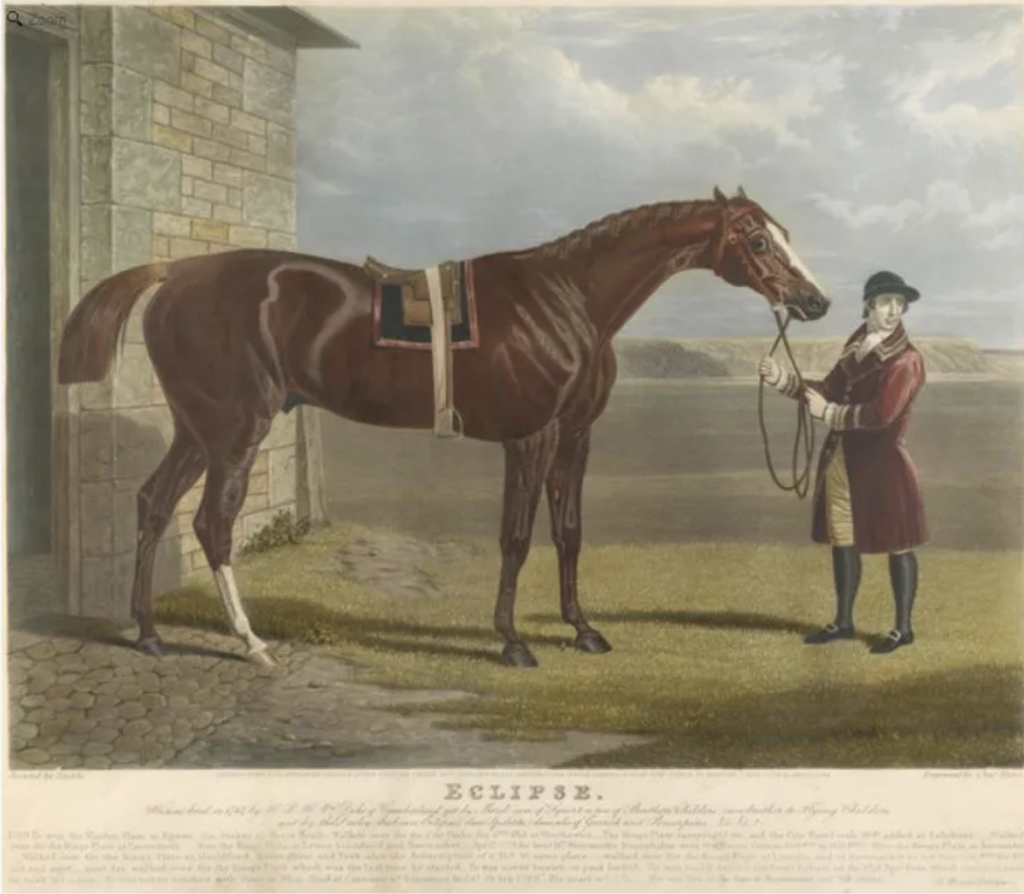
Because of his temperament, he didn’t start racing until he was five. Bookies arrived at the racing trials too late to find out whether or not rumours about his speed were true. However, it is alleged they met an old woman on the road home who reported she had seen a horse with a white leg – outrunning another far behind it. She claimed the second horse would never catch the first if they ran to the end of the earth! Despite never having won a race, Eclipse would start his first race as a 4-to-1 favourite.
His toughest race would be against Bucephalus. He would go on to win 18 races of which 11 were King’s Plates. From his imperious record came the phrase, “Eclipse first and the rest nowhere,” which phrase is still coined today. He is said to have been able to cover 23 feet in a stride, with a recorded top speed of 83 feet per second.
No one would compete against him, so he was retired to stud after 17 months. After his death due to colic in his 24th year, his necropsy would reveal an abnormally large heart of 14 lbs., double that of the average horse.
Eclipse traces his male lineage to the Darley Arabian, however his dam was a daughter of Regulus whereby tracing him also to the Godolphin Arabian.
The book King of the Wind was written in 1948 as a fictional biography of the Godolphin Arabian. It depicts Agba as the Arabian’s lifetime stable boy. The true story, however, follows similar biographical lines. He was originally presented to the King of France, Louise XV, and then allegedly utilized as a cart horse. One of his peculiarities was his heart-felt attachment to his constant companion, Grimalkin, the cat.
Ultimately, this stud would become the leading sire in Great Britain and Ireland between 1738 and 1747, and through his lineage, and eventually that of Eclipse, the Thoroughbred line would be established.
In 1970, the Royal Veterinary College established that nearly 80 per cent of Thoroughbred racehorses had the Eclipse genetics in their pedigree. Recent determinations establish that number at a much higher 95% – virtually “every living Thoroughbred” evolved from the lineage of Eclipse. The lineage can be traced back to virtually one line, one heart.